
School learning, mastered
Maths, science, history, English and more, from Grade 1 to university — real curriculum, real explanations, turned into games that make knowledge stick through play and retrieval, not worksheets.
✦ The future of learning
KinPella is family learning for all ages — the school subjects that matter now, plus the future skills that decide what comes next: coding, AI literacy, money and study skills. One shared screen becomes the game board, every phone becomes a controller, and everything you need to become successful in life turns into a game the whole family plays together.
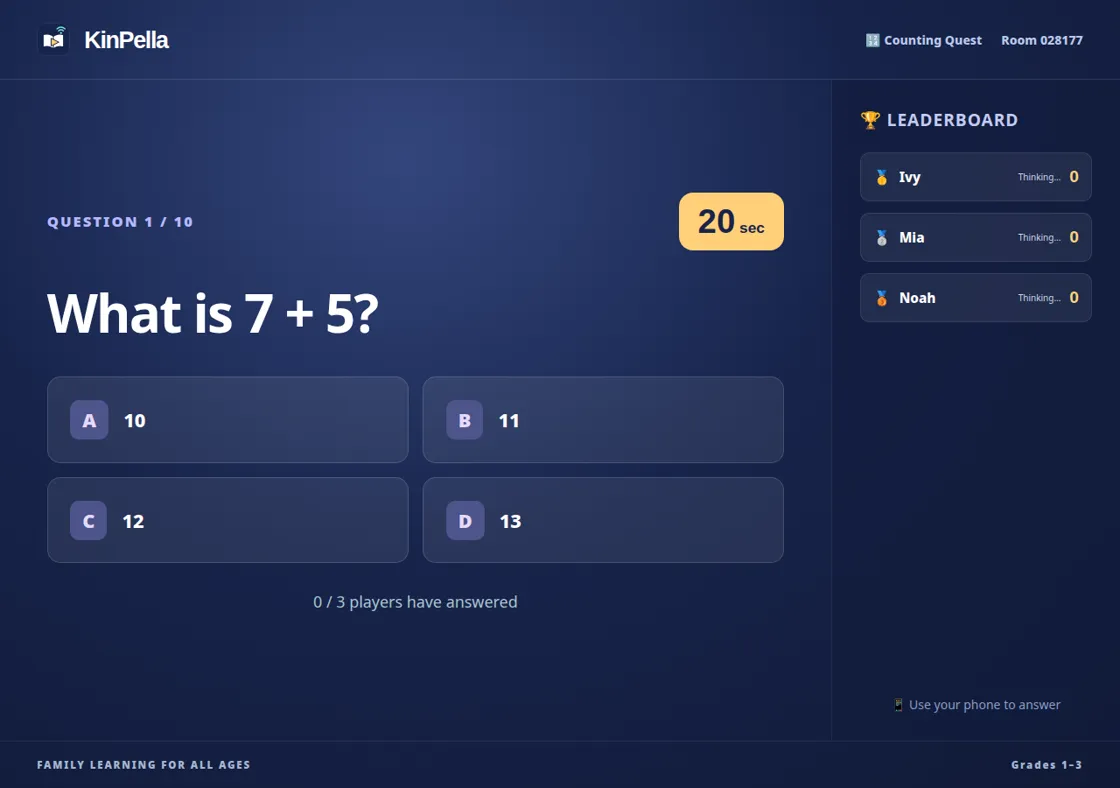
📺 Live on your TV — phones as controllers
✦ Welcome back
Pick up right where you left off — one tap, no sign-up.
✦ Why KinPella exists
Maths, science, history, English and more, from Grade 1 to university — real curriculum, real explanations, turned into games that make knowledge stick through play and retrieval, not worksheets.
Coding, AI literacy, data thinking and digital detective skills — the subjects school is still catching up with, introduced at every age level so no child meets the future unprepared.
Money sense, critical thinking, study skills and new languages: the capabilities that decide how far learning carries into adult life, practised together as a family long before they are needed.
✦ How it works
Open KinPella on a TV or laptop, pick a course and a game mode, and a private room appears with a six-digit code.
Players enter the code on their own phones — no accounts, no downloads. Their answers stay private until the reveal, so nobody copies and nobody is put on the spot.
The server keeps the timer and the score fair. Every answer is revealed with its explanation, and a full recap at the end shows what everyone learned.
✦ Four ways to play
The original race. Everyone answers on their own phone, fastest correct answers score most, and every reveal comes with the explanation — so the game itself teaches.
Sun versus Moon. Players are balanced onto two teams and points roll up into team totals, so a great answer from the youngest player can win it for everyone.
The whole group against one shared boss. Every correct answer deals damage, individual scores are never shown, and the family or class wins together — built for younger children.
Lightning language rounds. Fifteen seconds a question, big speed bonuses, Spanish and French packs only. Pure vocabulary adrenaline.
✦ Every age, every stage
First numbers, first words, first wonders — counting, sounds, animals and the world outside the window, all at a gentle pace.
223 courses →Where foundations turn into power: fractions, grammar, ancient worlds and the first real science, pitched for curious 9–12s.
167 courses →Algebra, biology, geometry and the human body — middle-school subjects made playable, with explanations that actually explain.
158 courses →Exam-grade material without the dread: economics, literature, democracy and chemistry, ready for revision nights.
170 courses →First-year favourites — calculus, statistics, data and critical thinking — for students who learn better by playing than by highlighting.
6 courses →Spanish and French from first greetings to full journeys, with listen-and-repeat audio built into the lessons.
2 courses →The forward track: artificial intelligence, emerging technology and the capabilities the next decade rewards — built for older students and ambitious families who want more than the school syllabus.
1 course →✦ Future skills spotlight
Technology · Grades 10–12
Computer concepts, online safety, and critical thinking.
Lesson: Digital literacy is about creating with technology and using it responsibly.
Technology · University
Programming logic, algorithms, and data structures.
Lesson: Computer science gives us tools to solve problems reliably.
Mathematics · Grades 4–6
Coin values, making change, totals, and saving.
Lesson: Money is just numbers you can hold! Once you know each coin, you can add, pay, and save with confidence.
Technology · Grades 1–3
Sequences, patterns, and giving clear instructions, no computer needed.
Lesson: Coding starts with clear steps! Coders give instructions in the right order, spot patterns, and fix mistakes — and you…
Technology · Grades 4–6
Loops, conditionals, variables, events, and debugging in block coding.
Lesson: Block coding lets you build real programs by snapping ideas together. Master variables, loops, and choices, and you ca…
Technology · Grades 10–12
Algorithms, decomposition, logic, and thinking like a programmer.
Lesson: Strong programmers are strong thinkers first. These ideas — breaking problems down, choosing efficient plans, and reas…
✦ Solo study, too
Every course opens with a short guided lesson and a practice prompt, then the quiz. Learners study on their own, at their own pace — and their progress is saved privately on their own device. No account, no cloud profile, nothing about a child ever leaves their browser.
Start studying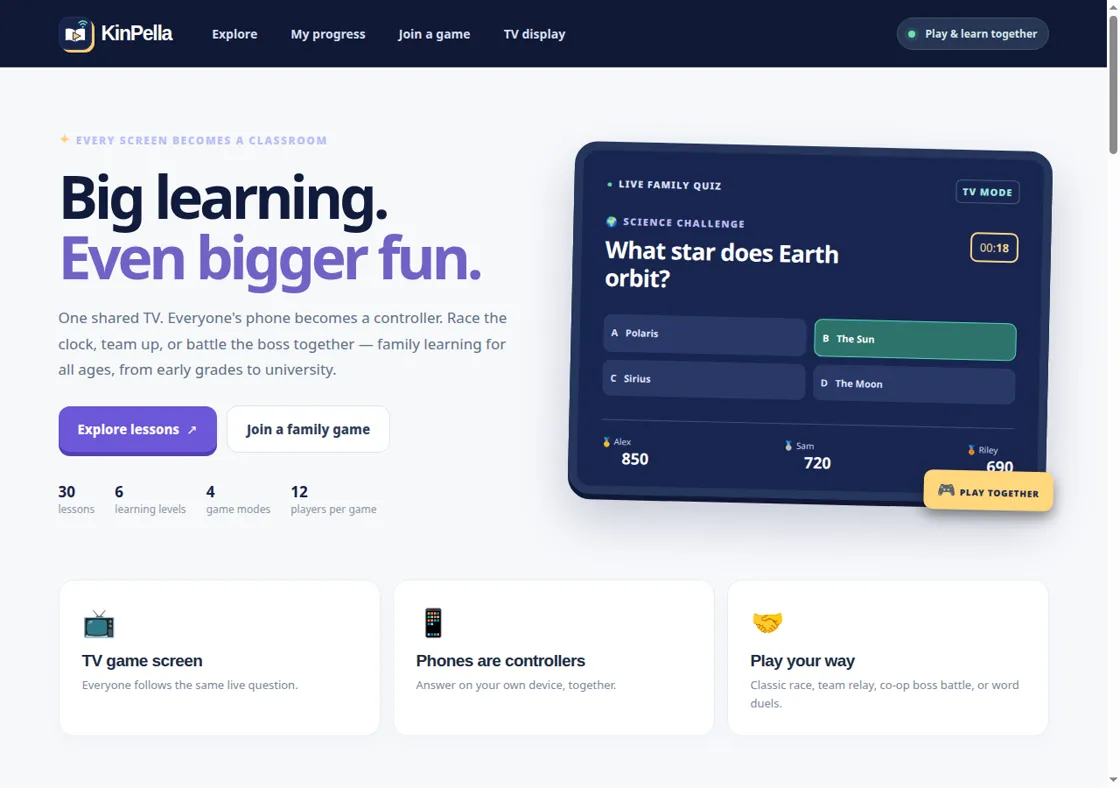
✦ From the learning guides
Family nights
A practical, step-by-step plan for a family quiz night that mixes ages fairly, keeps energy high, and sneaks in real learning — including what to do when someone keeps losing.
Read the guide →Parenting & screens
Not all screen time is equal. How to tell passive watching from active learning, what to look for in an educational app, and simple rules that turn a tablet from a pacifier into a teacher.
Read the guide →Grades 1–3 · Maths
Number confidence in the early grades is built from counting, patterns, and small wins — not speed drills. A parent-friendly guide to what matters at ages 6–9 and how to practise it painlessly.
Read the guide →Private room codes. No children's accounts or public profiles. No advertising, no analytics, no tracking — and solo progress that never leaves the learner's own device. That is not a policy bolted on afterwards; it is how KinPella is built.
Open KinPella on the TV or laptop, share the six-digit code, and every phone in the room becomes a controller. No sign-up. No downloads. No ads.